This video can not be played
Donald Trump's latest pronouncements on Iran and the chances of a negotiated agreement have to be taken seriously, as he is after all the president of the United States.
This is what he said at the Nato summit in Turkey.
"I don't want to deal with them anymore, they're scum. You know what scum is? They're scum. They're sick people. They're led by sick people. And they're vicious, violent people.
"And if they had a nuclear weapon, they'd use it. As far as I'm concerned, it's over."
But are they his last words on the subject? Certainly not. He has kept up a running commentary on the war and the memorandum of understanding (MOU) that is being negotiated. His words have swerved through claims of victory to threats of annihilating Iranian civilisation to support for negotiations.
Later he doubled down on his latest threats, saying the US "will probably hit them harder again tonight", adding "I gave them a little warning. We're going to hit them hard again tonight".
America's capacity to hit Iran, doing great damage, is not in doubt. But what it has not been able to do is to break the will of the regime to drop any of its fundamental demands, starting with control of navigation through the Strait of Hormuz.
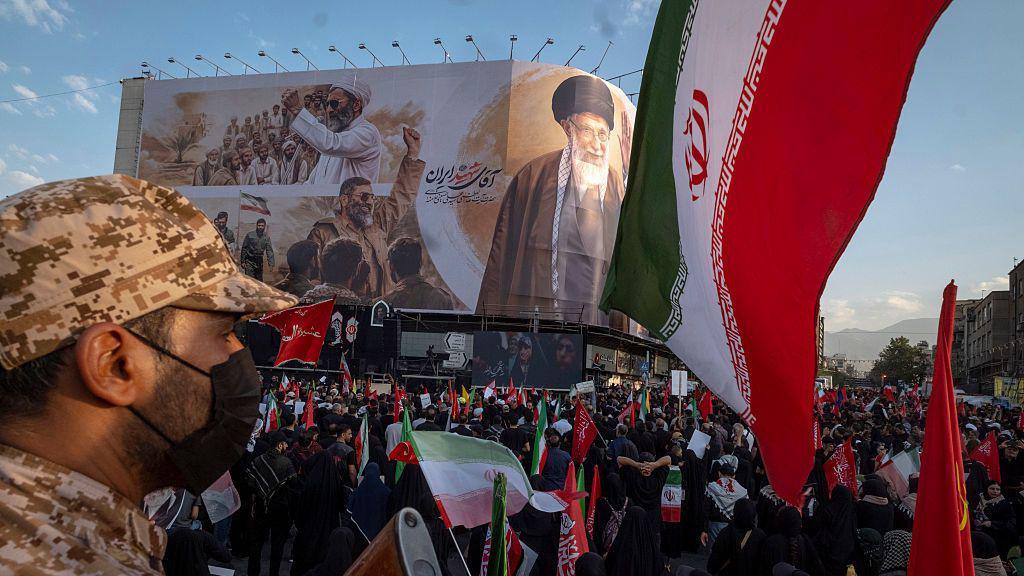
Buried in his latest verbal onslaught was an acceptance that the talks will continue. They have been on hold while Iran goes through days of funeral obsequies for its former supreme leader Ayatollah Ali Khamenei, who was killed by Israel and the US on the first day of the war on 28 February.
Trump was asked if the exchange of strikes between the US and Iran - and by extension some of America's Arab allies in the Gulf – meant the talks between them were over.
Referring to his chief negotiators, Steve Witkoff and Jared Kushner, he said "I don't care, they can talk. But I think they're wasting their time."
Then, on the Iranian regime: "They're a bunch of lying guys."
That can be read as another admission that the president of the US, for all his bluster, does not have a better option than negotiations. With Israel, the US tried and failed to destroy the Iranian regime.
But the negotiating process is fragile. A source among the mediators trying to make them work described what has happened as "a setback for sure". The atmosphere is said to be "very tense".
That is a diplomatic way of saying that events of the last few days are a terrible backdrop for talks between two powers that have zero trust that the other will keep its word if a deal is made.

At the heart of the latest military exchanges between Iran and the US is the Tehran regime's determination not to return to the way things were before the US and Israel attacked on 28 February.
The regime is determined to keep control of the Strait of Hormuz. The ability to stop shipping carrying global essentials including a fifth of the world supply of oil and gas gives it a chokehold on the world economy.
It is a much more usable weapon than the possibility that it will try to develop a nuclear weapon.
Iran will not agree to relinquish control of the Strait of Hormuz. That is why it is prepared to risk the MOU – which is laden with potential sweeteners for Iran – to make the point that there is no going back. It is prepared to gamble on continued war to protect what it believes are its strategic rights in the Strait.
The regime in Tehran has been emboldened by the failure of the US and Israel to destroy it. The funeral rituals of the supreme leader killed when they launched their campaign have demonstrated that the Islamic regime has a strong core of support.
Domestic opposition has not gone away. But the regime's ruthless use of force to crush protests, killing thousands, back in January for protesting in the streets means that it is keeping a low profile.
If the escalation between the two sides can be stopped, mediators involved in the negotiating process believe it is possible to do a deal with Iran that will allow shipping to transit the Strait. It would have to be part of a wider agreement that unfreezes Iranian assets held abroad, allows Iran to sell its oil and most critically for the regime acknowledges Iran's authority over the Strait.
In return Iran would have to accept limits on enriching uranium, allow UN nuclear inspectors back in, and to account for stocks of what Trump calls "nuclear dust" – in other words uranium already enriched close to levels that could be used to make a nuclear weapon.
But events of the last 24 hours show how hard that will be.