
Strolling through the magnificent grounds or walking the walls of Framlingham Castle, Suffolk, it’s not hard to imagine the 12th century fortress, home of the Earls and Dukes of Norfolk for four centuries, as a place of influence and power. But for a short while in July 1553, it was the most important place in Britain. For Mary Tudor, whose younger half-brother Edward VI had removed her from the line of succession before his death aged 15, the stronghold was her base of operations. From here, Mary plotted her campaign to depose Edwards’s half-cousin and preferred successor, Lady Jane Grey, and become Queen.
Protected by a mere and surrounded by parkland and estates, it was an ideal location for her stand against the Duke of Northumberland, John Dudley whom she suspected of having influenced her dying brother to exclude her. Having stated her claim to the Privy Council, she was pronounced Queen of England on July 19 while at Framlingham. For the first time, England had an acknowledged queen (Lady Jane would be nicknamed the “Nine Days Queen” and later beheaded). As you walk in Mary’s footsteps, watch out for Tudor brickwork and chimneys as well as five medieval stone heads set in the walls. Top up your energy after exploring with a treat from the castle café.
Another Mary whose fortunes fell at an English Heritage castle was Mary, Queen of Scots, cousin of Mary Tudor and Elizabeth I. Born in 1542, Mary became unpopular as Queen of Scotland after marrying a Catholic and was eventually deposed. Trusting her fate to her cousin Elizabeth I, she travelled to England but two days later was escorted to Carlisle Castle, Cumbria. Kept in captivity for several weeks in May 1568, it was one of a series of “prisons” that held Mary for 19 years before her execution in 1587 aged 44.
We're giving away the passes to our Express Premium customers – you can subscribe here – but you can also get them by buying the Daily Express any day this week. Each pass is valid until Sunday June 14, 2026, inclusive for one use only per household and terms and conditions apply. In the meantime, here are some English Heritage sites guaranteed to bring out the secret agent in everyone!
Read more: Explore the wonders of English Heritage thanks to the Express
Read more: Free English Heritage pass for Express Premium subscribers

For 500 years, until the English and Scottish crowns were united in 1603, Carlisle Castle was the principal fortress of England’s north-western border and one of the most besieged castles in England – surviving seven sieges by the Scots between 1174 and 1461. Mary was held in what was then known as the Warden’s Tower, in the south-east corner of the inner ward, under the watchful eye of Sir Francis Knollys. He let her stroll on the grass in front of the castle – thereafter known as “the lady’s walk” – and watch members of her entourage playing football.
Today you can follow that same walk, visit the remains of Queen Mary’s Tower and explore the ancient keep. Also marvel at the First World War Bible that stopped a bullet and drums touched by Napoleon in Cumbria’s Museum of Military Life. Younger visitors can follow the Folktale Creature Trails to discover magical creatures from English myths and legends.
Another site that helped change the course of royal history is Boscobel House and The Royal Oak, Shrops, where Charles II, eldest son of the executed Charles I, hid after losing the Battle of Worcester on September 3, 1651. Fleeing the Parliamentarians, Charles sought refuge in a tree for 14 hours to evade his pursuers and later hid under the attic stairs, in a secret place similar to priest-holes once used by Roman Catholics escaping persecution.
His dramatic escape and subsequent restoration to the throne in May 1660 made both the house and the Royal Oak, as it became known, popular tourist attractions which they remain. The lost oak pasture has been restored, including trees propagated from the original Royal Oak and a replacement grown from an acorn planted by the then Prince of Wales in 2001.
There’s a stunning 17th century-style garden, complete with box hedges, and a Victorian farmyard. Younger visitors will love the grass maze and 28 metre-long willow tunnel – which snakes through a field next to the garden – or hiding in the “secret places” in the outdoor play area.

In Falmouth, Cornwall, Pendennis Castle became the westernmost of Henry VIII’s “device” forts – a series of structures built to defend the coast of England and Wales with artillery. Henry’s divorce from the Spanish Katharine of Aragon and the withdrawal of the English Church from the authority of the Pope increased the danger of war against France and the Holy Roman Empire.
A series of fortifications were subsequently built around the coast from south Wales to Berwick-Upon-Tweed, known as the “Device by the King”. These included forts at Deal, Walmer, Hurst, Calshot, Pendennis and St Mawes – all built to site cannons to protect vulnerable anchorages and harbours.
Today you can climb to the top of Pendennis’s Tudor keep for stunning views over the Fal Estuary and Falmouth Bay. Or follow the tunnel down to the Half Moon Battery and be transported back to the Second World War. Look out for “firing days” when guns are operated by volunteers.

St Mawes Castle near Truro faces Pendennis across Carrick Roads in the Fal Estuary. Both have been enlarged since the 16th century, but Henry VIII’s buildings survive with few alterations. St Mawes is stamped with the King’s identity and that of his son, Edward.
The oldest surviving part of York Castle, northern England’s greatest medieval fortress, Clifford’s Tower contains a technological marvel that helped change the world for the better – what may be England’s oldest flushing toilet.
Its crowning glory, however, is its new timber roof platform, giving access to 360-degree panoramas over York and further afield. The raised earthwork was once the site of a timber keep built by William the Conqueror. It burnt down during the worst event in the site’s history: the massacre of York’s Jewish community in 1190. After the fire, the tower was rebuilt very shortly afterwards. Further repairs and rebuilding took place in the castle during the mid-13th century. As you make your way around the tower, you’ll be immersed in the sounds of the past; be transported to a busy 14th century kitchen, listen to medieval gossip and learn about the construction of the original Norman wooden keep in 1069.
Walmer Castle and Gardens in Kent was built in 1539–40 by Henry VIII in response to threats of invasion from Europe. The castle was part of a 2.7-mile coastal barrier that included Deal and Sandown castles. Since the 18th century, Walmer has been official residence of the Lord Warden of the Cinque Ports – a series of south-east coastal ports including Sandwich, Dover, Hythe, New Romney and Hastings.
By the mid-18th century, the castle had become a well-equipped seaside retreat as well as a fort. Notable Lords Warden include William Pitt the Younger, the Duke of Wellington, W H Smith and Queen Elizabeth, the Queen Mother – who was Lord Warden from 1978–2002 and the only woman to hold the office. The Queen Mother loved Walmer and visited most Julys – often with one or more of the royal corgis. In 1997, Pitt’s walled garden was re-made to mark her 95th birthday and now forms the tranquil Queen Mother’s Garden, with a summerhouse and raised arbour (the yew castle) at opposite ends. The Queen Mother once remarked: “I have been given many flowers before, but never a garden.”

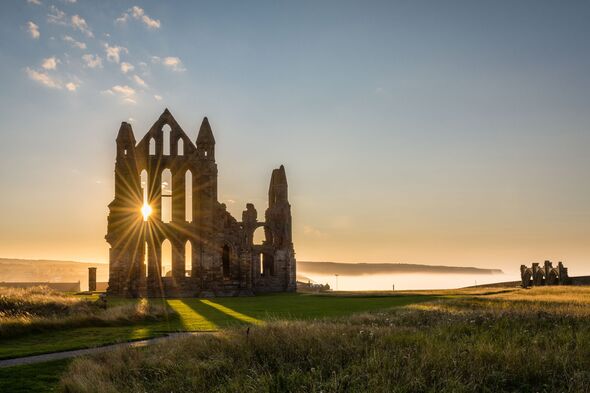
Whitby Abbey in North Yorkshire might have helped inspire Bram Stoker’s Dracula, but its ruins, set high on the clifftops overlooking the sea, tell only part of the site’s incredible story. Communities have lived on this headland for more than 3,000 years and it was a holy place and seat of power.
Buried beneath the soaring arches are the remains of an earlier Anglo-Saxon monastery, whose tales of saints, poets and miracles still survive. In AD 657 the pioneering Abbess Hild founded a monastery on land given by the Northumbrian King Oswiu. It became one of the most important religious centres in England. In the 13th century, the monastery was rebuilt – today the vast shell of the ruined abbey church is a magnificent example of Early English Gothic architecture.
The visitor centre tells the abbey’s 3,000-year story including objects like Anglo-Saxon crosses, medieval manuscripts and even a rare copy of Dracula signed by its author. Roam the wide-open spaces of the abbey grounds, enjoy a relaxing picnic and play hide and seek among the ruins.

Old Sarum in Wiltshire is one of the most enthralling and historically important sites in southern England. Today you can still walk round its mighty prehistoric outer ramparts, raised by Iron Age people in about 400 BC, while at the centre are the huge Norman inner mound and ditch, founded by William the Conqueror. Climbing onto the mound, you can trace the ruins of the Norman royal castle. Around it, a bustling new city sprang up – including a cathedral. But the city’s glory days were numbered and the settlement migrated downhill to New Sarum – today known as Salisbury – where a new cathedral was founded in 1220. The castle remained an administrative centre until the 15th century but, by Tudor times there wasn’t a single inhabited house left on the hilltop. Eleanor of Aquitaine was imprisoned here by her estranged husband Henry II for supporting a rebellion of their sons against him. She was given fine clothes and good food.
She was released in 1189 and lived to see her sons Richard I and John become kings. To the north-west of the inner-bailey lie the foundations of the cathedral. Today, with 29 acres of beautiful, rare grass chalkland to discover, and far-reaching views across the Wiltshire countryside, Old Sarum is the perfect place to explore on foot. Bring a picnic, and find a peaceful spot to enjoy the butterflies and kestrels, which can often be seen hovering over the outer bailey, then take one of the many footpaths crisscrossing the ramparts and look out for the tall spire of the Salisbury Cathedral.