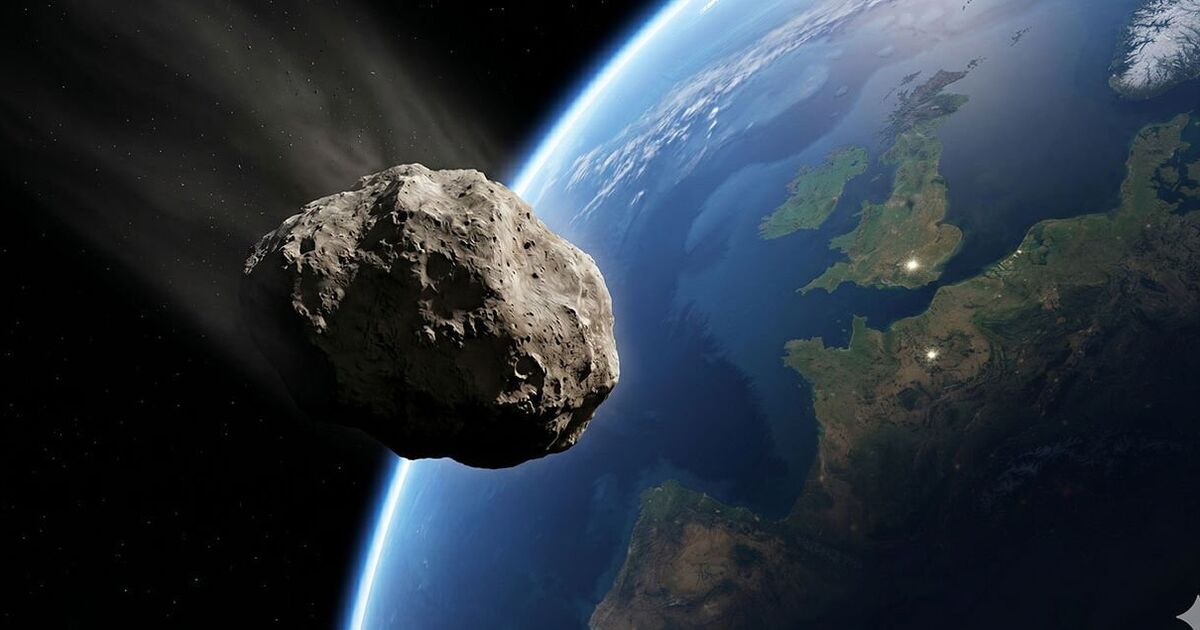

A newly discovered asteroid will pass Earth at a distance of roughly 90,000 km (56,000 miles) tomorrow, in what astronomers describe as one of the closest safe flybys on record.
The object, designated 2026 JH2, will make its closest approach on Monday, May 18, 2026, at approximately 21:23–21:57 UTC. This is just under a quarter of the average distance to the Moon and closer than many satellites in Earth orbit.
Astrophysicist Mark Norris from the University of Lancashire told New Scientist: “In astronomical terms, it’s as close as you can get without hitting. It’s the kind of thing that would ruin a city quite efficiently, if it hit.”
The asteroid, an Apollo-type near-Earth object, was discovered on May 10, 2026 by the Mount Lemmon Survey in Arizona and quickly confirmed by other observatories.
With an absolute magnitude of around 26.1, it is estimated to measure between 15 and 35 metres (50–115 feet) across, comparable in size to the object responsible for the 2013 Chelyabinsk airburst over Russia.
Current orbital data from dozens of observations indicate no risk of impact, either now or for the foreseeable future. The minimum orbital intersection distance is low, but refined calculations confirm a safe miss. The asteroid follows a highly elliptical 3.8-year orbit that takes it from just beyond Earth’s path out towards Jupiter’s distance.
Despite the dramatic proximity, 2026 JH2 poses no danger. At peak brightness during the flyby, it is expected to reach about magnitude 11.5 — visible through modest amateur telescopes under dark skies, particularly in the northern hemisphere, but too faint for naked-eye observation. It will appear in the constellation Ursa Major. The Virtual Telescope Project in Italy plans to livestream the event.
The flyby offers a valuable opportunity for planetary defence research. Close encounters like this allow astronomers to refine orbital parameters and improve understanding of small near-Earth objects.
However, its detection only days before the closest approach has highlighted ongoing challenges in spotting smaller “city-killer” asteroids in advance.
Mr Norris’s assessment underscores the destructive potential of such objects. An impact from a body in this size range could generate an airburst or ground explosion capable of devastating a urban area, producing shockwaves, thermal effects, and widespread damage similar to — or exceeding — the Chelyabinsk event, which injured more than 1,500 people.
Astronomers continue to monitor the asteroid closely. For the latest tracking information, the public can consult NASA’s Jet Propulsion Laboratory Small-Body Database or the Minor Planet Center.