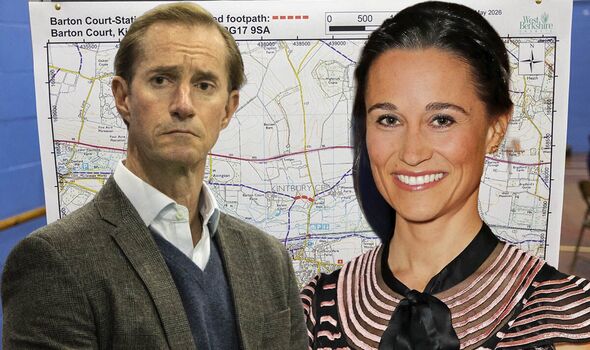

Pippa and James Matthews have been told security concerns will not be considered by an inquiry deciding if a right of way can be declared on the couple’s sprawling country estate. At a hearing in the scenic village of Kintbury, West Berks, today the Inspector for the Secretary of State for Environment, Food and Rural Affairs stated the issue would not be part of proceedings at the centre of a row over public use of the path on the Matthews’ land.
Mr Matthews, 50, wearing a dark blazer and racing green V-neck jumper, appeared with his legal team at the hearing held in a sports hall packed with villagers.
Princess Kate’s younger sister and her husband are battling a bid by The Ramblers (formerly the Ramblers Association) to secure access to a 400m path on their 145-acre 18th-century Grade II-listed Barton Court estate. Pippa, 42 and James share the 32-room £15m country pile, which was used as a prep school until the 1970s, with their three children.
Read more: Heartbreak for Kate's sister Pippa as she 'admits defeat and sells £1.3m zoo'
Read more: Locals fume at Princess Kate's sister after sudden closure on estate

The royally-connected row began in 2022 when the Matthews installed gates blocking a route, known locally as Mill Lane, which campaigners claim has been used for decades by villagers.
Mill Lane crosses the Matthews’ estate and connects two popular approved public footpaths used by picknickers, families, children and walkers. One of these paths runs from the pretty St Mary's Church over the nearby Kennet and Avon Canal.
The case on Mill Lane will be decided if campaigners can persuade the Inspector it has reasonably been used as a right of way by the public for 20 years up to 2022.
Barton Court, which was previously owned by Habitat founder Sir Terence Conran, sits to the west of Mill Lane, a path residents claim they use to avoid the alternative “dangerous” stretch of Station Road.
Speaking on behalf of the Matthews, barrister Paul Wilmshurst said the decison to stop the path being private was “not a question of whether it’s a good or a bad thing” and “nothing to do with what people might want to be the case”.
He said there were a “number of clear reasons, looking at the history of this land, why this area is not a public footpath”.
After the Matthews moved into their palatial property the gates appeared at the eastern end of the route, blocking public access and appalling some residents and ramblers.

In 2024 West Berkshire District Council sided with walkers and proposed Mill Lane should be recorded as public on the Definitive Map and Statement of Public Rights of Way.
During sometimes terse exchanges with the Matthews’ legal team, life-long villager Samuel Robins, 29, told the inquiry using Mill Lane was a “necessity” to avoid the “unsafe” Station Road, which he said often had traffic driving at more than the 40mph speed limit.
He said “categorically” he had never been stopped using the path on the Matthews’ land, which he claimed he had been doing up to at least four times a week since he was aged 11 in 2007.
He added it was “very difficult to understand” any security concerns as Barton Court was “clearly visible” from other paths in the area.
Mr Robins added that “families” and “young children” had lost the “amenity, freedom and independence” since Mill Lane was closed off.
Cross-examined by Mr Wilmshurst, Mr Robbins said he contacted The Ramblers after he had gone to use the route and discovered it was blocked off.
Mr Wilmshurst said Mr Robins was giving evidence using memories from when he was a child and it was “much more difficult” to remember things from that time. Mr Robins agreed with this.
Mr Robins said he used Mill Lane to get to a former job as a gardener for a “world famous author” living nearby.
It’s understood the garden is that of best-selling Conclave author Robert Harris who is known to live locally.
Michael Barthorpe said he had lived in the village since 1986. He said had used the Mill Lane to walk his dog since 2016 on the “safe route” between the two local public footpaths near to the Barton Court estate.

In a statement Sophie Redmond, programme manager for paths, from The Ramblers, said: "This is just one example of the thousands of miles of local paths across Britain that are missing, blocked or unusable, stopping people being able to access nature close to home.
“People in less well-off communities are more likely to lack safe, accessible paths that connect them to green space near where they live. This isn't just unfair, it's unhealthy. And it's deepening existing health and wellbeing equalities.
“That’s why we, The Ramblers, launched our Access Denied campaign to call on Governments to open up blocked paths and expand the path network to serve every community. Because without action, more paths will be neglected and lost.
“And more people will be denied their right to access nature.”
In a statement a spokesperson for the Matthews family said: “For as long as records exist, there has never been a footpath/public right of way on the land currently under discussion.
“For decades past there has always been signage pointing out this is the driveway to a private property, with no public access. There are other clearly marked footpaths nearby.
“Contrary to media reports the previous owners at the property from as far back as the 1970’s, did not allow public access to the land under discussion. It has always been private property.”
The Inquiry continues.