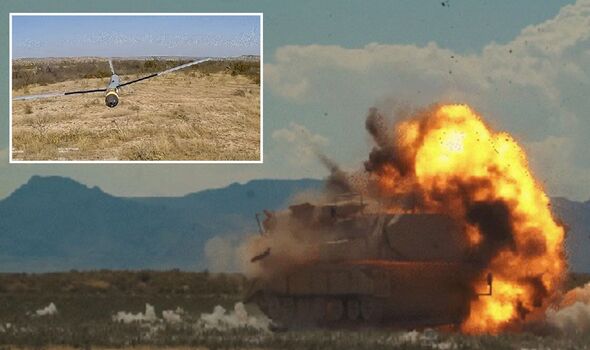

British soldiers who had never flown a drone in their lives are carrying out successful kamikaze strikes after just days of training on autonomous weapons — a development that could transform how the Army fights with its shrinking number of personnel.
Recruits from 11th Brigade — the Army's first formation specialising in robotics and uncrewed systems — undertook a crash course in hunting and destroying targets last week at an airfield in Llanbedr, south of Harlech in Wales.
The soldiers used simple computer prompts to operate Altius drones — loitering munitions capable of lingering in the air for hours and carrying out reconnaissance, electronic warfare or strike missions. After launch, an operator simply sets an altitude and waypoint on a digital map before selecting a mission from a drop-down list — options including "search this area", "arm warhead" and "engage target."
Altius, made by defence firm Anduril, runs on an AI-powered battle management system called Lattice, which enables drones to fly and identify targets autonomously — and to co-ordinate with a range of other aerial assets, vehicles and surveillance towers.
Read more: US air force issues major update on RAF Fairford fire after Iran bombing raids
Read more: Complete emergency 'go-bag' kit listed from the Government in case of WW3
An Anduril engineer told the Times: "The first thing we asked the guys we've been training on Monday morning was their experience with drones. Not a single person had flown one. It shows the simplicity baked into this system, which allows general infantrymen to conduct strikes after very little training.
"One guy was three weeks out of basic [army] training, he's an 18-year-old now delivering this capability. He was very nervous when he rocked up on Monday but you don't need to be a pilot to use these systems. The piloting, so to speak, is what we call autonomy."
About 30 troopers from three units took part in the training before further lessons with live explosives on Salisbury Plain. They used laptops and small console-style controllers to operate various drone models, tracking and attacking an inflatable tank using advanced autonomous systems.
Rich Drake, managing director of Anduril UK, said in the Times report, the technology aimed to "shrink the kill chain" by allowing a single soldier to operate many drones simultaneously rather than one device at a time — a crucial advantage for an Army struggling with personnel shortages.
Simon Luck, head of Europe at Anduril, reportedly said: "This is about how we bring mass to the battlefield. We don't have enough pilots for it to be one-to-one, we need one operator across many different units.

"The system itself is actually indicating and prompting those operators as to what they should do in terms of engaging with a target, then they can just click 'task' through Lattice. That will send a command to the robot to do that particular task: conduct surveillance or a strike.
"In a real-world scenario, you might have two or three of these drones — one [intelligence, surveillance and reconnaissance] asset and two munitions variants — already up and loitering in the environment being used in tandem by an operator."
Luck said modern warfare was already moving away from individually piloted drones. Learning to fly a first-person view drone takes two to six weeks — learning Lattice takes days.
He said: "If you think about the lessons in Ukraine, they have the operating model of an FPV pilot responsible for one particular drone. They're moving to a place where they want to have more autonomy in that kill chain, so that when they launch an interceptor it's automatically tracking and engaging that Shahed [enemy drone].
"We don't want to have an operator having to [manually] control every single drone we launch. What we're doing is showing the British Army that it can do that right now. It has the ability with these types of systems to have a fully autonomous end-to-end kill chain, with one pilot looking after a variety of different platforms."